
How Air Curtains Help Maintain Smoke-Free Escape Routes During Emergencies


When a fire breaks out in a building, the first thing that kills is rarely the flame. It is the smoke.
Smoke travels faster than most people expect. It fills corridors, stairwells, and exit routes within minutes — sometimes seconds — and turns what should be a clear escape path into a blind, suffocating tunnel. People panic. Visibility drops to zero. Emergency exits that are perfectly functional become unreachable simply because the air around them is unbreathable.
This is a building design problem that engineers and safety consultants have been trying to solve for decades. And one of the most practical, underused answers is already sitting above the doors of thousands of commercial buildings across India — the air curtain.
What an Air Curtain Actually Does
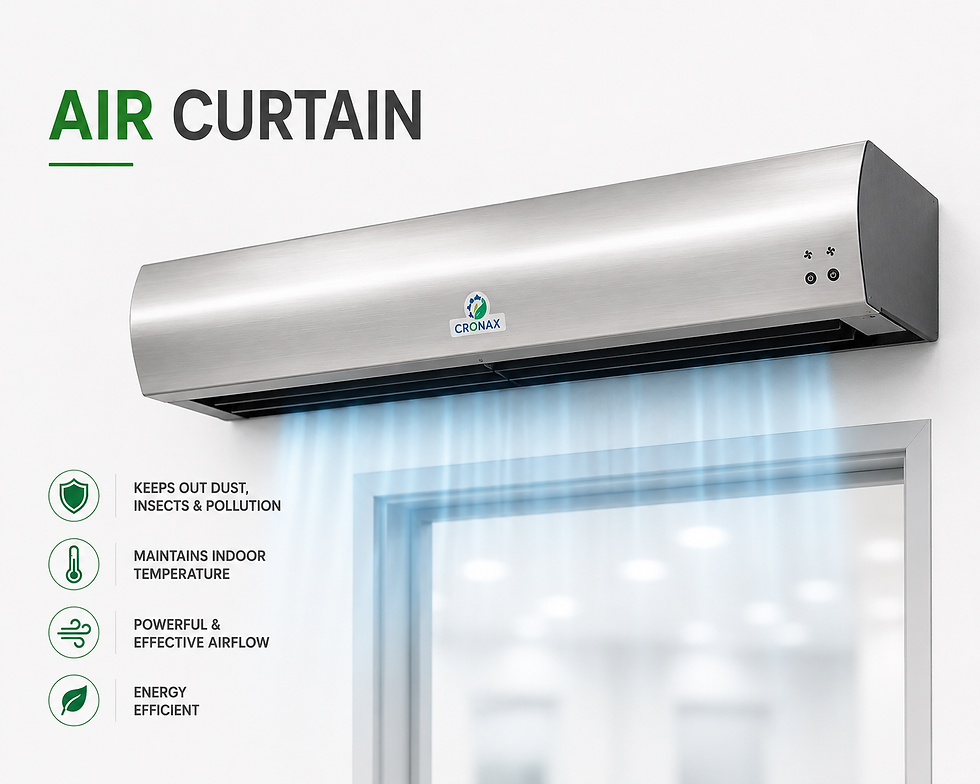
An air curtain is a device mounted above a doorway that projects a continuous, controlled stream of air downward across the opening. In normal conditions, it keeps outside air, dust, insects, and pollutants from entering a space. In an emergency, it does something far more critical — it creates an invisible barrier that smoke cannot easily cross.
The principle is simple. Smoke, like any airborne particle, follows air pressure and airflow. When an air curtain is running at the right velocity and angle, it disrupts the natural path that smoke would take through an opening. Instead of drifting freely from one zone into a corridor or stairwell, the smoke is deflected — kept on the side of the doorway where it originated.
This is not a theoretical benefit. It is the reason air curtains are increasingly being specified in fire safety plans for hospitals, shopping malls, hotels, metro stations, airports, and large commercial complexes across India.
The Escape Route Problem in Indian Buildings
Indian cities have a building stock that ranges from modern high-rises with full fire suppression systems to older commercial complexes where fire safety infrastructure is minimal. Even in newer buildings, the focus tends to be on sprinklers, alarms, and fire doors — with less attention paid to how smoke moves through the building during evacuation.
Escape routes — stairwells, fire exit corridors, refuge floors — are designed to remain clear during emergencies. But if the doors leading into those spaces are open (as they will be when dozens of people are rushing through them), smoke follows people right into the exit path.
A fire-rated air curtain installed at the entry points of these escape routes keeps the airflow moving outward — away from the stairwell or corridor — so that even when the door is held open by evacuating occupants, smoke infiltration is significantly reduced.
For building owners, facility managers, and safety officers, this is the gap that a well-chosen air curtain fills.
Where Air Curtains Matter Most in Emergency Scenarios
Stairwell Entrances Stairwells are the primary vertical escape route in any multi-storey building. They are also natural chimneys — smoke rises and fills them quickly. An air curtain at each floor entry point helps maintain a pressure difference that resists smoke entry, keeping the stairwell breathable during evacuation.
Fire Exit Corridors Horizontal escape corridors connecting fire exits to the rest of a floor are vulnerable the moment a door opens. Air curtains at strategic points along these corridors help maintain separation between smoke-affected zones and clear escape paths.
Lift Lobbies and Refuge Areas In tall buildings, lift lobbies on refuge floors serve as holding areas where occupants wait for evacuation assistance. Keeping these areas smoke-free is critical. Air curtains add a layer of protection that standard fire doors alone cannot always provide when people are moving through continuously.
Hospital and Healthcare Facilities Hospitals carry an additional challenge — patients who cannot evacuate quickly. Maintaining smoke-free zones in wards, operating theatres, and ICUs is not just a safety measure; it is a life-safety necessity. Air curtains help protect these critical areas from smoke infiltration, even as other parts of the building are being evacuated.
Hotels and Hospitality Venues Guests unfamiliar with the building layout are among the most vulnerable in an emergency. Keeping lobby exits, stairwell entrances, and corridor access points clear of smoke — especially in the first few minutes before emergency services arrive — can make a decisive difference.
Air Curtains and Fire Safety Compliance in India
India's National Building Code (NBC) and various state fire safety regulations have been evolving steadily, with increasing emphasis on smoke control as part of overall fire safety planning. While air curtains are not yet universally mandated the way sprinklers or alarms are, they are increasingly being recognised by fire consultants and safety auditors as a credible, complementary smoke control measure.
For buildings that are seeking fire safety certifications, green building ratings, or preparing for third-party safety audits, air curtains at escape route entry points are a straightforward addition that strengthens the overall safety case.
They are also one of the few fire safety measures that provide tangible, daily operational benefits — energy efficiency, temperature separation, dust and insect control — making them easier to justify in a project budget than a system that only activates during emergencies.
Choosing the Right Air Curtain for Fire Safety Applications
Not every air curtain on the market is appropriate for use in fire safety contexts. Here is what matters when specifying one for emergency escape route protection:
Air Velocity and Coverage The curtain needs to project air with enough velocity to create an effective barrier across the full width and height of the doorway. Undersized units or poorly matched specifications leave gaps that smoke can exploit.
Motor and Control Reliability In an emergency, the air curtain needs to function. Units with robust motors, reliable control systems, and the ability to integrate with building fire alarm panels — so they activate automatically when an alarm triggers — are the right choice for safety-critical applications.
Heat Resistance In fire scenarios, ambient temperatures near doorways can rise significantly. Air curtains specified for emergency use should be rated to operate in elevated temperature conditions without failure.
Certification and Testing For any application where fire safety is the primary requirement, the product should carry relevant certifications and have been tested for performance under emergency conditions. This is not an area to compromise on product quality.
What Building Owners Often Get Wrong
The most common mistake is treating all air curtains as interchangeable. A unit selected for a supermarket entrance to keep air conditioning in is not automatically suitable for a fire escape corridor.
The second mistake is installation without integration. An air curtain that has to be manually switched on during an emergency is far less effective than one that activates the moment a fire alarm is triggered. Proper integration with the building management system or fire alarm panel is not optional — it is the difference between a safety system and a piece of equipment that happens to be in the building.
The third mistake is neglecting maintenance. An air curtain that has not been serviced in two years may not deliver the airflow its specification promises. In a normal day, a degraded curtain is an inconvenience. On an emergency day, it is a liability.
Cronax Industries — Air Curtain Supplier and Manufacturer in India
Specifying the right air curtain for a fire safety application requires more than picking a product from a catalogue. It requires understanding the doorway dimensions, the expected airflow conditions, the building's fire safety design, and how the curtain will integrate with existing systems.
Cronax Industries is a respected air curtain manufacturer in India with experience supplying air curtains across commercial, industrial, institutional, and hospitality projects. As a trusted air curtain supplier, Cronax Industries works with architects, fire safety consultants, facility managers, and building contractors to help specify the right product for the right application — whether that is a standard commercial entrance or a fire-rated escape route installation.
Among the best air curtain brands in India, Cronax Industries stands apart for the quality of its products, the range of options available, and the technical support provided through the specification and installation process. If you are looking for a reliable air curtain brand in India that understands both the product and the application — whether for day-to-day efficiency or emergency safety — Cronax Industries is the name worth speaking to.
Conclusion
Air curtains are not a replacement for sprinkler systems, fire doors, or smoke extractors. They are a complement — an additional layer of protection that addresses a specific and serious vulnerability in how buildings handle smoke during evacuations.
The escape route that looks clear on a floor plan can become impassable within three minutes of a fire starting in an adjacent space. An air curtain, properly specified and installed, is one of the most effective ways to buy the time that people need to get out safely.
In a country where high-density buildings, mixed-use developments, and large public venues are growing faster than fire safety infrastructure, that extra layer of protection is not a luxury. It is a responsibility.
Cronax Industries supplies air curtains for commercial, industrial, institutional, and fire safety applications across India. For product specifications, project consultations, or site assessments, contact the Cronax Industries team.

Comments