
Are Air Showers Worth the Investment for Industrial Cleanrooms?

Every cleanroom project has a moment where someone looks at the air shower line item and asks the question out loud.
"Do we actually need this? Can we manage without it?"
It's a fair question. Air showers aren't cheap. They take up space at the cleanroom entry. They add a step to the personnel entry protocol. And on the surface, they look like equipment that does something growing already handles.
The short answer is — growing doesn't handle it well enough. And the cost of finding that out through batch rejections, failed audits, or contamination events is significantly higher than the cost of the air shower that would have prevented them.
Here's the honest case for why air showers are worth the investment — and how to think about the ROI before you sign a purchase order.
The Problem They're Solving Is Real
Start with the physics.
Every person entering a cleanroom is shedding particles — continuously, regardless of what they're wearing. Skin cells, hair fibres, lint from garments, and microorganisms transferred during gowning. A full cleanroom suit reduces this shedding significantly. It doesn't eliminate it.
Personnel consistently account for the majority of particulate events in ISO-classified cleanrooms. Not equipment failures. Not HVAC faults. People.
The particles that cause contamination events in pharmaceutical batches, semiconductor components, and medical device assemblies don't come from nowhere. They come in on people — often people who went through a proper gowning protocol and still carried surface particles on their suits into the controlled environment.
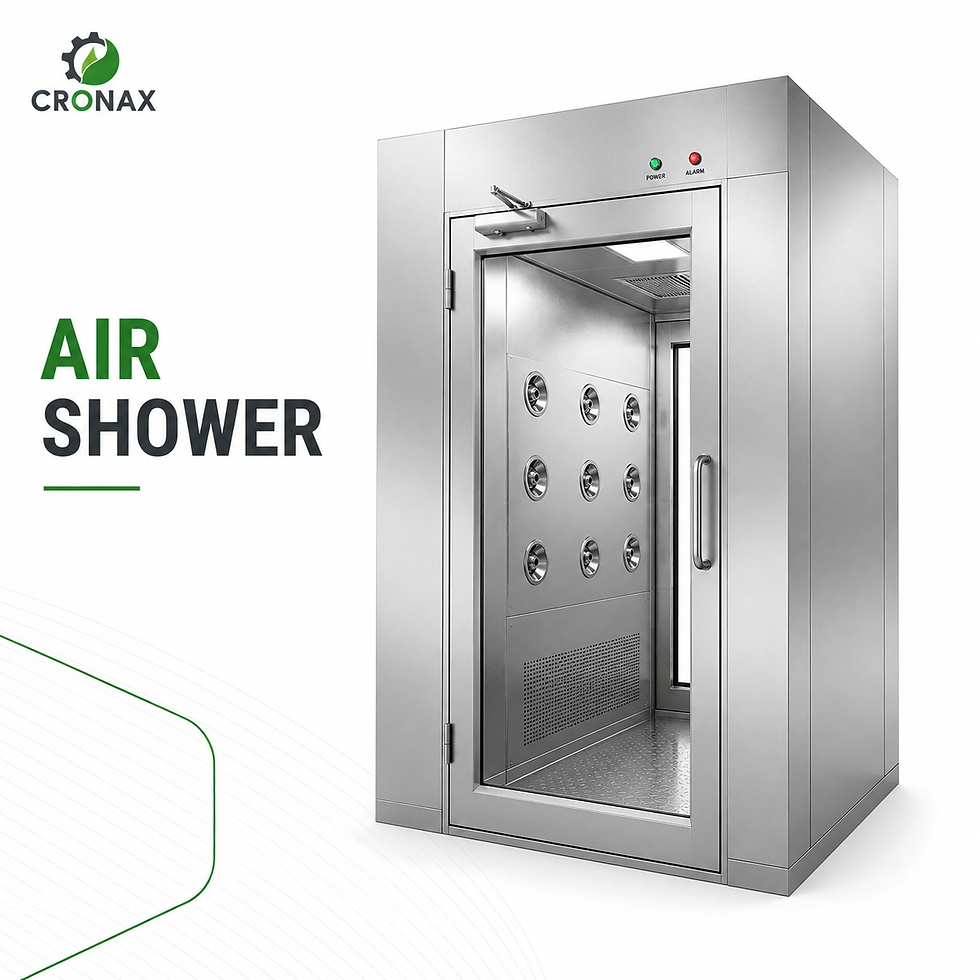
An air shower is the mechanical step between gowning and entry. High-velocity HEPA-filtered air at 25 to 30 m/s blasts the gowned person from multiple directions for 15 to 30 seconds. The turbulent airflow physically dislodges particles from fabric surfaces — the ones that survived gowning — before they reach the production zone.
Without this step, those particles go straight in.
What a Contamination Event Actually Costs
The ROI case for an air shower starts here — with the real cost of what it prevents.
In pharmaceutical manufacturing, a single contaminated batch means scrapping the product. For a mid-sized Indian pharma unit producing injectable formulations, one batch failure can represent ₹15 lakh to ₹50 lakh in lost active pharmaceutical ingredients, labour, and packaging — before accounting for production schedule disruption and regulatory documentation requirements.
A USFDA Warning Letter tied to contamination control deficiencies is a different order of cost entirely. Response, remediation, legal review, production hold, and reputational damage can run into crores. Several Indian pharmaceutical companies have experienced exactly this, and the inspection findings consistently point to inadequate contamination control at cleanroom entries as a contributing factor.
In semiconductor and electronics manufacturing, a contamination event at the wafer level can affect yield across an entire production run. At the component level, contamination affects reliability in ways that don't always show up immediately — creating field failure risks that are expensive to trace and more expensive to recall.
The air shower that prevents one batch rejection in a pharma facility pays for itself — completely — in that single event. Everything after that is net saving.
The Filter Life Benefit Nobody Talks About Enough
Here's an ROI angle that often gets overlooked in the investment conversation.
The cleanroom's primary HEPA and ULPA filtration — the ceiling-mounted FFUs and supply air filters — is expensive to replace and requires validation after each change in regulated environments. The more particle load these filters handle, the faster they reach their replacement point.
When personnel enter a cleanroom without going through an air shower, they carry a surface particle load that, over time, contributes to the contamination load the cleanroom's primary filtration has to manage.
A properly functioning air shower room removes a significant portion of this surface particle load at the entry point — before it reaches the cleanroom environment and its primary filters. Facilities that have tracked filter replacement intervals before and after air shower installation consistently report a 25% to 40% extension of primary filter service life.
For a large pharmaceutical facility running multiple cleanroom suites with HEPA arrays across thousands of square metres of ceiling, this extension in filter life represents a direct and quantifiable cost saving — on top of the contamination prevention value.
The Compliance Value — Separate From the Operational Value
For facilities operating under regulatory oversight, an air shower carries compliance value that's distinct from its operational ROI.
GMP guidelines, WHO technical reports, USFDA expectations, EU Annex 1 requirements — all of these frameworks expect that pharmaceutical facilities operating above a certain cleanroom classification have active contamination control at personnel entry points. An air shower at the cleanroom entry is demonstrable evidence of that active control.
During a USFDA inspection or EU-GMP audit, the inspectors walk through the entry protocol. They look at the gowning area, the air shower room, the interlocking door controls, and the cycle time settings. They ask about maintenance records and filter change logs. A facility with a properly functioning, documented air shower system is in a measurably stronger position than one relying on gowning alone — regardless of whether there's been a contamination event.
In the Indian pharmaceutical industry, where USFDA Warning Letters have had real operational and financial consequences for dozens of companies over the past decade, this compliance value is not theoretical. It's the difference between maintaining export market access and losing it.
The air shower clean room entry system is part of what gets you through an inspection. Factoring that value into the investment decision is as important as the direct operational ROI.
Different Applications — Different Payback Timelines
Not all cleanroom environments have the same ROI timeline for air shower investment.
Pharmaceutical manufacturing (API and formulations): Fastest payback. Batch values are high, regulatory scrutiny is intense, and a single contamination incident easily exceeds the capital cost of the installation. Most facilities in this category see payback within the first preventive event, which typically occurs within the first operating year.
Medical device manufacturing: Similar logic. ISO 13485 compliance requirements and the liability exposure from a contamination-related product recall make the investment straightforward to justify.
Semiconductor and electronics fabrication: High yield sensitivity and significant per-wafer or per-component values make contamination prevention worth considerable investment. Payback is tied to yield improvement rather than batch rejection prevention — but the direction is the same.
Biotech and research laboratories: Longer payback timeline because batch values are variable and research contamination events don't always have a direct financial equivalent. The investment case here is more about data integrity and research validity than direct financial loss prevention.
Food-grade production and packing: Compliance-driven rather than batch-value-driven in most cases. The ROI case is strongest where FSSAI audit risk or export market certification requirements make contamination control documentation valuable.
What Drives the Cost — And Where to Spend Wisely
Air shower systems vary significantly in price based on configuration, filtration grade, casing material, and control system specification. Understanding what drives the cost helps buyers make smarter decisions about where to invest and where not to.
Filtration grade. H14 HEPA is the standard for most pharmaceutical GMP applications. ULPA is specified for ISO Class 5 and above. The difference in filter cost is meaningful — specify the grade your cleanroom classification actually requires, not the highest available grade by default.
Casing material. SS 304 stainless steel is the correct specification for pharmaceutical and food-grade environments. MS powder-coated is acceptable for electronics manufacturing environments where chemical cleaning is less frequent. Don't upgrade casing material beyond what the application requires.
Configuration. Single-person units handle most laboratory and smaller production facility requirements. Multi-person or tunnel configurations add cost but reduce entry time for high-traffic facilities. Size to your actual peak entry volume, not your maximum theoretical occupancy.
Control system. Programmable cycle time, differential pressure monitoring, filter life alarms, and digital displays add value in regulated environments where documentation is required. Basic on/off control is sufficient for applications where compliance documentation isn't the primary requirement.
Interlocking quality. This is not the place to cut costs. Electromagnetic interlocking that prevents both doors from opening simultaneously is a safety and compliance requirement. Mechanical interlocks are less reliable under heavy use. Specify electromagnetic for any regulated application.
Cronax Industries — Air Showers Built for the Investment to Make Sense
For cleanroom projects where the air shower investment needs to actually deliver ROI — not just look correct on the specification sheet — Cronax Industries is a manufacturer who understands the difference.
Cronax Industries manufactures air showers, air shower rooms, and air shower clean room entry systems across the full range of configurations: single-person, multi-person, tunnel, cargo, and anti-static. SS 304 construction as standard. H14 HEPA filtration with ULPA options for higher-classification environments. Electromagnetic interlocking doors. Adjustable high-velocity nozzles. Programmable cycle control with differential pressure monitoring and filter life alerts.
For regulated pharmaceutical and medical device facilities, Cronax supports IQ/OQ qualification documentation — the Installation Qualification and Operational Qualification records that USFDA and EU-GMP inspectors look for. This documentation support isn't a service add-on; it's part of how they approach projects for GMP environments.
Their air velocity specifications are verified, not just listed. Nozzle exit velocity at 25 to 30 m/s is confirmed with instrumentation before delivery, because the performance that justifies the investment depends on the unit actually reaching the specified velocity, not just being rated for it on paper.
For procurement teams and facility managers evaluating air shower investment for a new cleanroom or an upgrade to an existing facility, Cronax Industries provides the application knowledge and product depth to make the specification conversation a productive one.
The Straightforward Answer
Are air showers worth the investment for industrial cleanrooms?
For pharmaceutical, biotech, medical device, and semiconductor facilities operating under regulatory oversight — yes. The contamination prevention value, the compliance assurance, the primary filter life extension, and the documentation support for regulatory inspections combine to make the ROI case clearly positive.
For lower-risk applications — food packing, general manufacturing, research labs with less intensive regulatory exposure — the answer depends on your specific risk profile and the value of what's being produced in the cleanroom.
The one case where air showers are never worth the investment is when they're specified incorrectly — wrong velocity, wrong filtration grade, wrong interlocking configuration — and then installed in a facility where nobody verifies whether they're actually working. An air shower that runs its cycle but doesn't generate adequate air velocity does not prevent contamination. It's providing false assurance.
Buy the right system. Verify the performance. Maintain it properly.
Cronax Industries builds air shower systems for exactly the facilities where getting this right isn't optional.
Looking for the right air shower or air shower room for your cleanroom? Talk to Cronax Industries about the specification that fits your ISO class, entry volume, and compliance requirements.


Comments